Full-time MSc study entails a 12-month programme, split between Leeds and Sheffield campuses. In order to complete the full MSc programme, you must complete the eight lecture modules and a major project, as described below. Each module is valued at 15M (Masters credits), and the project is valued at 60M, giving a total of 180M credits.
Module 1B: Generic Methodologies for Bionanotechnology (CMNS5110)
Introduction to nanotechnology and overview of nanoscale materials; effect of length scale on properties; introduction to bionanotechnology; challenges and opportunities associated with biology on the Nanoscale; bionanotechnology systems; introduction to bioelectronics and biophysics; preparation methods for molecular nanostructures, self assembly and templating; surface patterning and functionalisation; soft lithography contrast with conventional lithography). Characterisation techniques for molecular nanostructures; scanning probe microscopy; electron microscopy and compositional analysis of soft matter; fluorescence; NMR; surface characterisation; surface plasmon resonance, ellipsometry, dual polarization interferometry, SAXS, XPS.
Module 1B
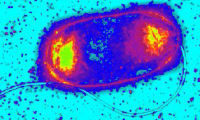
Above: A TEM micrograph of a bacteria, the gradient color indicates the different density regions highlighting the subcellular compartments, bacteria membrane, and the flagella.
Module 2B: Physics for Bionanotechnology (MAT6740)
Students will be introduced to elements of biophysics and physics at the nano-scale so provide breadth to their education. The course will span from basic principles of thermodynamics, transport phenomena, Low-Reynolds number fluid dynamics, quantum mechanics, and examples of how nature produce and convert energy.
Module 2B
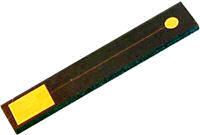
Above: A low-cost biosensor for monitoring myoglobin, a key indicator of myocardial infarction, developed at Leeds.
Module 3B: Biosensors (CMNS5700)
Introduction to biosensors; the biological component; the sensor surface; Immobilisation of the sensor molecule; Transduction of the sensor signal -Optical sensors; Transduction of the sensor signal – Electrochemical sensors; Electrochemical considerations; Transduction of the sensor signal, mechanical sensors; Suppression or substraction of non-specific background interaction at sensor surfaces; Sensor stabilisation; Data analysis.
Module 3B
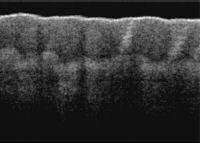
Above: Optical coherence tomography scan of human finger tip in-vivo.
Module 4B: Biophotonics and bioimaging (MAT6750)
This 15 credit module provides a comprehensive overview of the practical and theoretical aspects of imaging biological systems, from the cellular level through to whole-body medical imaging. The unit starts with an introduction to biophysics and then moves on to describe the basic physical concepts in imaging. Major techniques using ionising and non-ionising radiation are then introduced including fluorescence and multi-photon microscopy, spectroscopy, OCT, MRI, X-ray CT, PET and SPECT imaging.
Module 4B
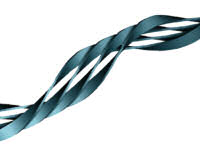
Above: Fibrillar structure formed by the self-assembly of four ribbons of peptides.
Module 5: Self-assembling nanostructured molecular materials and devices (CMNS5500)
This module covers the principles of self-assembly, self-organisation and its application to biology. Also covered is phase behaviour, structures and properties of thermotropic and lyotropic liquid crystals, block copolymers, and ordered colloidal dispersions.
Module 5
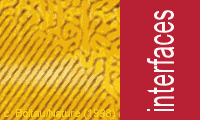
Above: Chemical patterning of a polymer film.
Böltau et al. Nature 391 877 (1998).
Module 6: Macromolecules at interfaces and structured organic films (PHY6006)
This module covers the principles of surface and interface chemistry. It includes techniques for surface manipulation, coatings and non-lithographic pattern methods; inorganic/organic hybrid interfaces; interaction of fluids with natural and patterned surfaces.
Module 6
Module 7B: Nanotoxicology (CMNS5850)
Principles of toxicology; toxicology models, experimental toxicology studies; detoxification mechanisms; chemical speciation of dissolved species; importance of biological membrane in toxicology; Toxicology and bioaccumulation of particles; Environmental behaviour and speciation of particles; Introduction to nanomaterials; General surface and colloid chemistry, principles, experimental techniques, surface potential, DVLO theory; Characteristics of nanoparticles; Environmental behaviour of nanoparticles; Case studies of nanomaterial biological activity; Application of toxicology studies to study toxicology and bioaccumulation of nanomaterials.
Module 7B
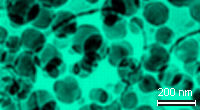
Above: Cryogenic transmission electron micrograph of polymeric vesicles (false colour).
Module 8NM: Bionanomaterials (MAT6730)
This module introduces basic concepts of cell and molecular biology, before looking at examples of how biomolecules can be used for designing nano-structures, and the use of these nano-structures in biological and medical applications.
Module 8NM